




Attack Framework
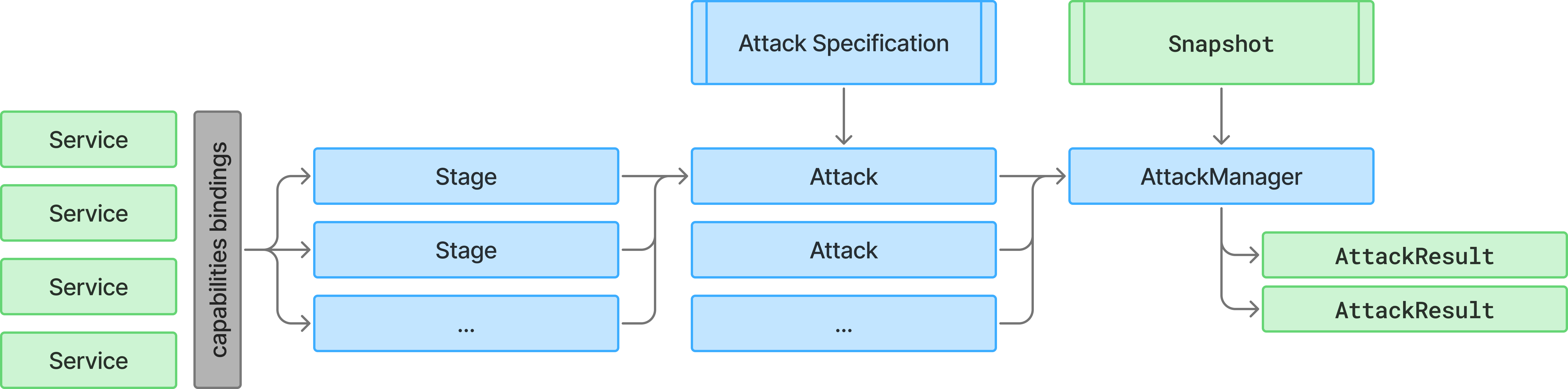
The adversary framework executes declarative, event-driven attacks against live behavior services in the simulation runtime. Attack behavior is described in YAML, converted into structured specs, and evaluated on every simulation tick against a normalized snapshot of vehicle and RSU service state.
The framework is generic at the orchestration layer. See module-level architecture, Behavior Services for the behavior-service lifecycle and development template, Available Attacks for the builtin attack catalog, and Attack Configuration Reference for the YAML reference.
Enabling Attacks
Scenario configs enable attacks through the top-level attacks list:
attacks:
  - aim_server_response_jamming
  - aim_client_identity_spoofing
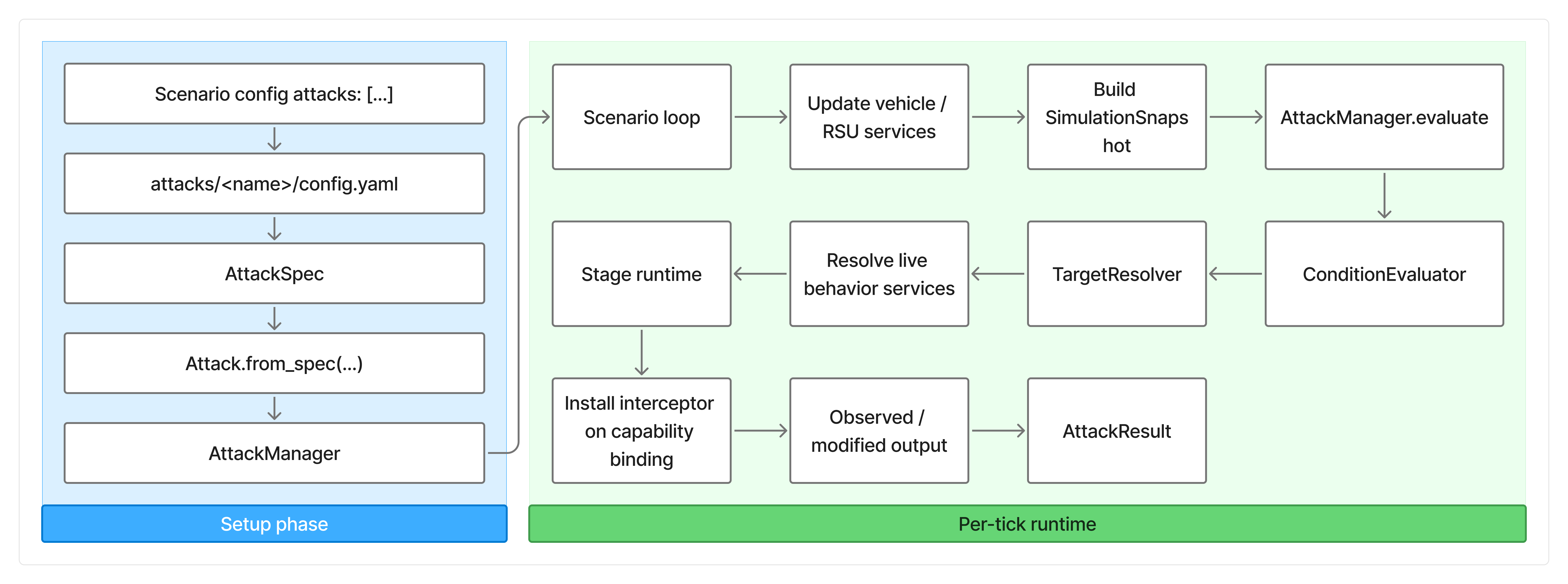
Each attack name is resolved to:
opencda/core/attack/adversary_framework/attacks/<attack-name>/config.yaml
At scenario startup, each YAML file is loaded, parsed into an AttackSpec,
and converted into a runtime Attack object via Attack.from_spec(...).
Runtime Integration
The framework is evaluated from the main scenario loops. On each tick, the scenario code:
updates vehicle and RSU behavior services,
builds a
SimulationSnapshot,calls
AttackManager.evaluate(...),resolves live target services through
CavWorld.resolve_behavior_services.
The overall per-tick attack evaluation workflow is shown below.
The snapshot passed to the attack framework has the following structure:
@dataclass(frozen=True, slots=True)
class NodeSnapshot:
    node_id: str
    node_type: str
    service_states: dict[str, Any]

@dataclass(frozen=True, slots=True)
class SimulationSnapshot:
    tick: int
    vehicle_nodes: tuple[NodeSnapshot, ...]
    rsu_nodes: tuple[NodeSnapshot, ...]
service_states contains the latest get_state() outputs of attached
behavior services, keyed by service_type.
Core Components
AttackManager
AttackManager owns the previous snapshot and advances all configured
attacks against the current snapshot. It is responsible for:
checking attack start and stop triggers,
resolving target services for attacks that should run,
executing active stages,
emitting
AttackResultobjects,logging success, stop, and failure outcomes.
If an attack start trigger fires but no target services can be resolved for that tick, the manager reports that attack execution as failed.
Attack
Attack is the runtime object built from AttackSpec. It stores:
the parsed spec,
runtime lifecycle state,
ordered stage runtimes,
per-stage last results.
The default lifecycle is:
an inactive attack may start when its requirements and start trigger are satisfied,
the first stage starts when the attack becomes active,
every later stage starts after the previous stage reaches
success,an attack stops when its stop trigger fires,
an attack succeeds when all stages complete successfully.
ConditionEvaluator
Conditions are evaluated against:
the current and previous
SimulationSnapshot,the current attack runtime,
the current stage runtimes.
Supported source kinds are snapshot, attack, and stage.
TargetResolver
Target resolution currently supports one strategy: service_state_field.
The resolver:
reads one snapshot field,
normalizes its value into one or more node ids,
resolves live behavior services for those node ids,
optionally filters by
service_type.
Builtin Stages
Builtin stages are auto-registered through AttackStageRegistry when the
framework module is imported.
sniffer
Passive observer that records outputs returned by matched capability handlers.
Default capability:
response.observeSupported capabilities:
request.observe,request.submit,response.observe,response.submit,command.submit,state.observeParameters: none
dropper
Replaces selected outputs with an empty batch or probabilistically drops items from iterable outputs.
Default capability:
response.submitSupported capabilities:
request.observe,request.submit,response.observe,response.submit,command.submitParameters:
drop_rate(floatin[0.0, 1.0], default1.0),seed(optional RNG seed)
replayer
Replays the previous output seen on each matched service/capability binding.
Default capability:
response.submitSupported capabilities:
request.observe,request.submit,response.observe,response.submit,command.submitParameters: none
spoofer
Rewrites selected fields inside TransportMessage envelopes or payloads.
Default capability:
request.submitSupported capabilities:
request.submit,response.submit,command.submitParameters: required
rewriteslist with per-rulepath,operation, andvalue
Capabilities
The current cross-service capability vocabulary is:
request.observerequest.submitresponse.observeresponse.submitcommand.submitstate.observe
Stages declare the capabilities they need, and the framework matches them
against each target service’s capability_bindings map.
Interception Model
Stages do not mutate the framework itself. Instead, they temporarily wrap the bound methods exposed by behavior-service capability bindings.
In practice, builtin stages install output interceptors on the resolved target
service instances and remove them later through deactivate() or when the
attack is stopped.
Results and Logging
The framework emits AttackResult objects with:
attack_namestatusreasonstage_history
Result statuses are:
successfailstop
Attack and stage runtime conditions use lifecycle status values such as
inactive, active, success, fail, and stopped. Internally,
the runtime also has a STARTED state, but condition evaluation normalizes
it to active.
The scenario loop currently relies on framework logging for visibility into attack execution.